Janggu장구
Follow the strokes of Gutgeori and Semachi at your own pace.
Real instrument recordings · Free · No accountJANGGU Deong · Gung · Deok
Tap to play · Keyboard A S D F G · Esc to stop
A SMALL JANGDAN
Gutgeori & Semachi practice
BPM counts the main beat. The National Gugak Center teaching examples use 66–90 for Gutgeori and 90–110 for Semachi, counting dotted-quarter beats. Defaults 75 and 90 are practice starting points within those examples; the 40–180 slider allows slower or faster practice.
Each cell is one subdivision. BPM counts the main beats.
One educational variant is played. Gideok spans a grace stroke just before the next Deok; Deoreoreo continues across two cells. The repeated Deok samples approximate a roll. Cells show subdivisions, not silence where the roll continues. Variants depend on the piece and tradition.
Janggu sound and practice
How is the sound made?
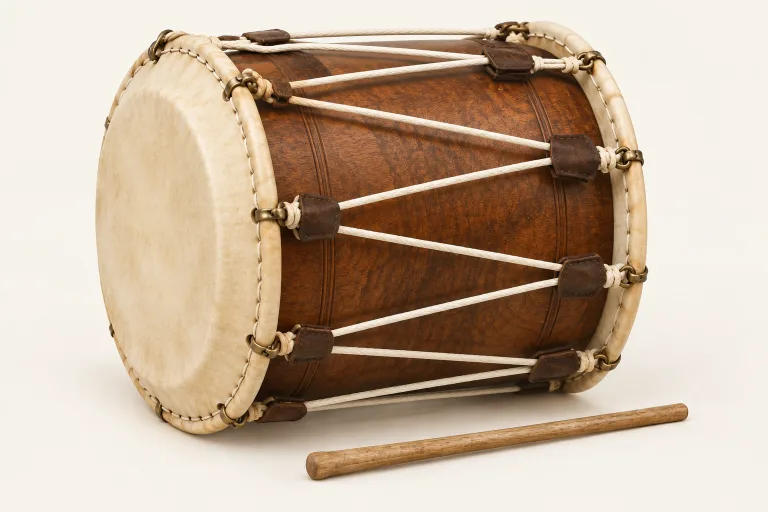
Janggu has two drumheads on an hourglass-shaped body. Here Deong represents both heads, Gung the gung side and Deok the chae side in a basic convention. Syllables and techniques may vary by tradition.
A task to try here
Tap Deong, Gung and Deok separately. Select Semachi, turn repeat off and hear one cycle. Count three subdivisions per main beat and follow Deong Deong Deok Gung Deok. Switch to Gutgeori to compare four main beats and its grace and roll figures.
How the tool differs from the instrument
Gideok uses two sampled strokes, one just before Deok. Deoreoreo repeats a Deok sample as an approximation. Real rolls, dynamics and stick rebound are not reproduced. Grace placement and roll spacing are educational choices, not a unique traditional answer.
These are UsefulSet listening and input tasks, not transcriptions of traditional pieces.
Try this
- Start at a low volume and explore one sound at a time.
- Start with Gutgeori at 75 BPM or Semachi at 90 BPM and follow the strokes.
- Repeat the difficult parts slowly and return to them in your next session.
Sound and storage
Uses edited National Gugak Center Deong, Gung and Deok recordings, without playback pitch shifts. Recordings: National Gugak Center · KOGL Type 1. Edited: note extraction, silence trimming, level adjustment, fades and MP3 conversion.
No microphone is used. Recording stores pressed notes and timing for up to two minutes and 1,000 notes in this browser. Clearing browser data removes them. Playback and recording stop when the tab is hidden. New Danso best scores are saved only when optional practice history is enabled and remain on this device.
Sample files and editing details
National Gugak Center single-note source IDs and filenames: 2283 · Janggu_1_2.wav; 2289 · Janggu_3_2.wav; 2295 · Janggu_5_2.wav
MP3 files used for this instrument: 3; edited by extracting notes, trimming silence, adjusting levels, adding fades and converting to MP3.
Recording stores note names and press times, not microphone audio, volume changes or an audio file. Replay uses the saved timing at the current volume. Starting a new recording replaces the previous one.
Rhythm references
National Gugak Center Gutgeori reference ↗ · Semachi reference ↗